
At the Hotel Chelsea, INDIE “Good Times” cover star Julia Fox reflects on past ghosts, New York states of mind, and the art of remembering
If walls could talk, the Hotel Chelsea’s wouldn’t know where to begin. Janis Joplin gave Leonard Cohen “head on the unmade bed” of Room 424 (if we’re to believe the lyrics). Patti Smith and Robert Mapplethorpe were Just Kids in Room 1017. Nancy Spungen was stabbed to death in Room 100, allegedly by the Sex Pistols’ Sid Vicious. Edie Sedgwick accidentally set her room on fire. Jackson Pollock once got wasted and threw up on the floor of the private dining room; Michael Imperioli swears he saw a ghost in the hallway on the eighth floor. Over the 142 years since its opening, the Hotel Chelsea, along with its residents and staff, has all but seen it all.
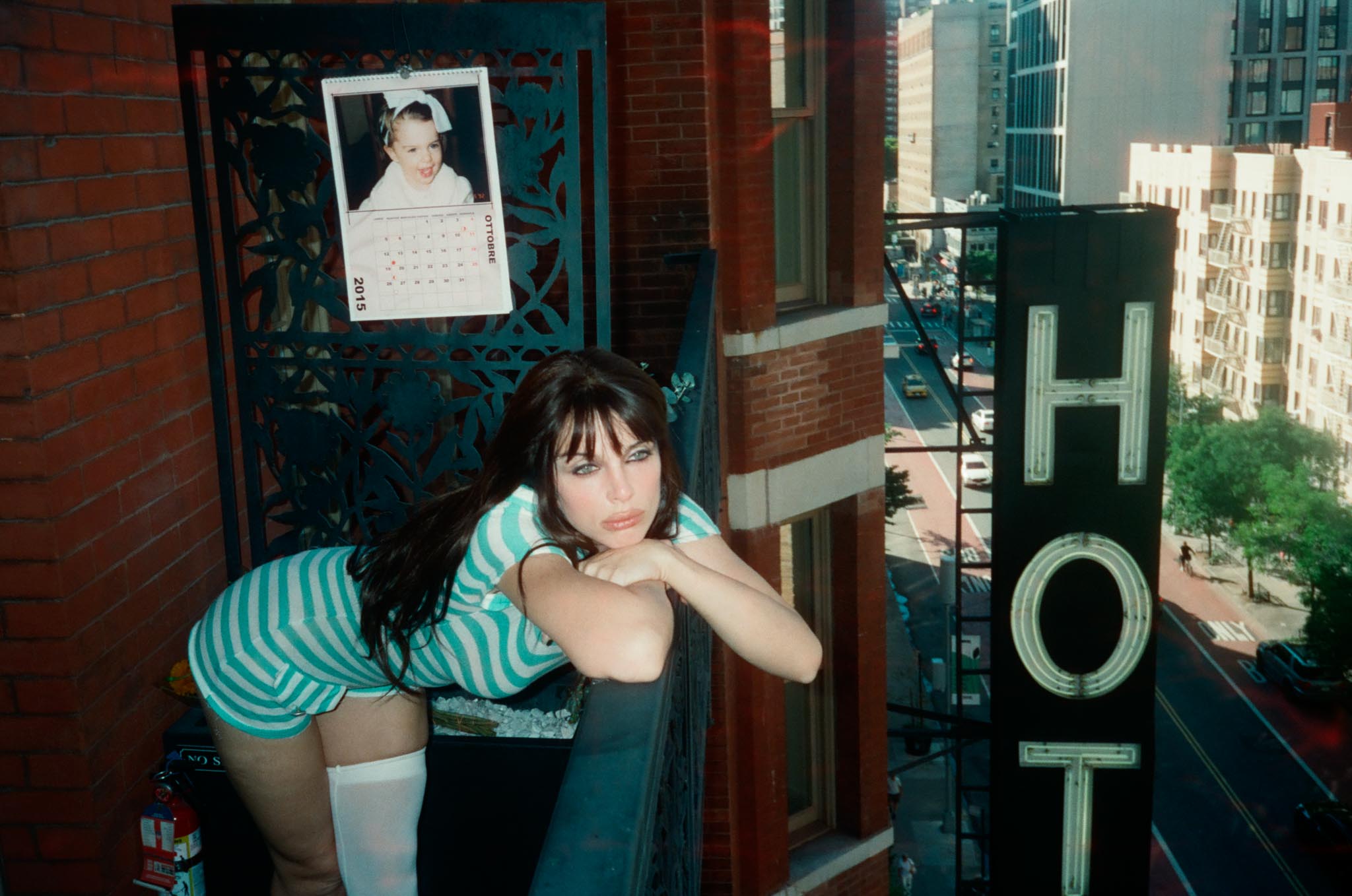
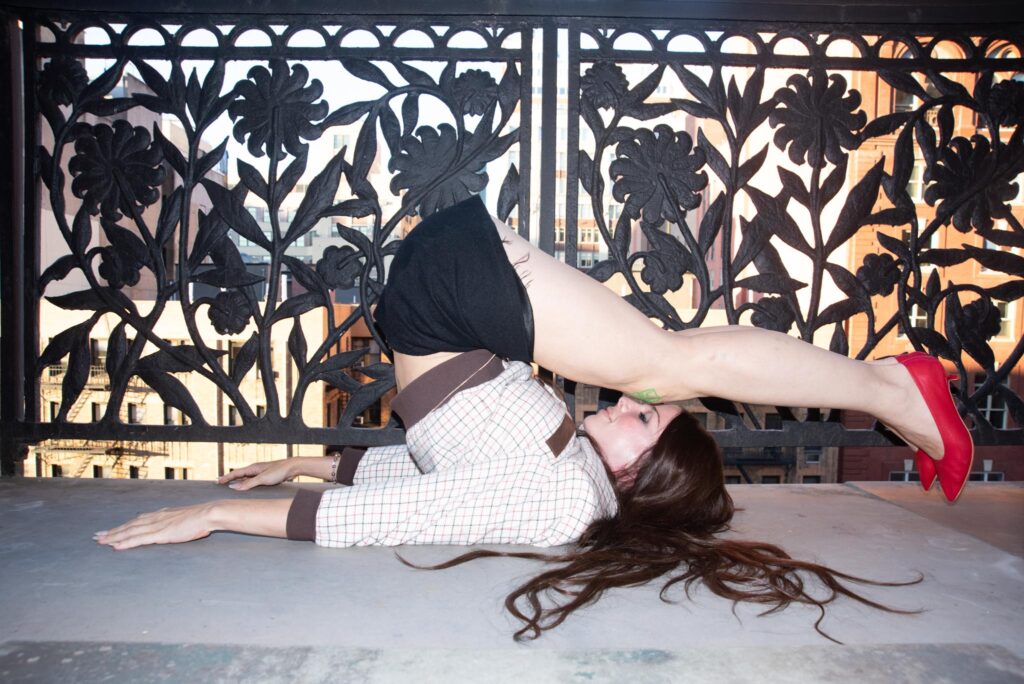
Perhaps that’s why, when Julia Fox is hanging upside down on a sixth-floor balcony one Saturday afternoon in August—or lying in the middle of the street outside the hotel’s entrance—nobody seems to bat an eyelid. Passersby simply pass by. Fox gets up from the ground, unfazed, only because a bus is coming. She is not, like many before her, a long-term resident of the Chelsea—the housing co-operative turned legendary artist haven—but for a few hours, on the day of this shoot, Room 6D belongs to her. Fox, like the Chelsea, has her fair share of stories. And Fox, like the Chelsea, is a New York City stalwart.

Jacket and skirt MARC JACOBS Leg garters SARAH APHRODITE Sunglasses STYLIST’S OWN Shoes JULIA’S OWN
As anyone who has read her book will no doubt tell you, Julia Fox has been through it. Born in Milan in 1990 to an Italian mother and American father, Fox spends her first few years in Saronno, where she is raised predominantly by her grandfather. As a child, she visits New York often—squatting in apartments her father is renovating, briefly living aboard his 20-foot sailboat. At six, she moves to Manhattan to live with him, speaking in broken English; missing her mother, her nonno, and her younger brother in Italy; seeking comfort in front of Maury and Jerry Springer. At nine, she’s an extra in an indie film her father’s friend is producing—before he’s found guilty of murdering the director, whose severed body parts are discovered stuffed in a suitcase on a street in Queens. Large swathes of Fox’s childhood are spent unsupervised, camping out at friends’ houses with little concern from her father. When her mother visits, there are fights, and she locks herself in the bathroom, using the hair dryer to drown out the noise. At twelve, she flirts with a man on Saint Marks to get a free tattoo and her nipples pierced. At 14, she moves back to Lombardy for middle school, following a whirlwind Italian summer spent smoking cigarettes, downing shots, and cozying up to older men on motorbikes. At 15, she gets kicked out by her host family. Back in New York, she falls in love with an abusive and two-timing drug dealer, and is arrested for stealing the contents of a Dior purse. At 16, she tries heroin for the first time; at 17, she overdoses.
Though her childhood reads like a gritty coming-of-age film, it was A24’s Uncut Gems (2019) that made her a movie star, when Fox featured alongside Adam Sandler in the Safdie brothers’ frenetic Diamond District thriller. And while then an unknown casting in Hollywood, she was already something of a self-described “hood celebrity” in New York. Some knew her as the designer and co-founder of knitwear brand Franziska Fox; others remembered her as the artist who staged her own funeral (for R.I.P. Julia Fox). Some had seen her graphic photographs of life, love, and addiction in the Louisiana bayou with members of the band SALEM. Josh Safdie had met her in a SoHo café and recognised her from seven-second video platform Vine. But as Julia (the character loosely based on and eventually named after her), Fox was being offered to a new audience. She was celebrated for her “scene-stealing” presence (The Guardian), her “dynamite” performance (Rolling Stone), and her “ferocity” (New York Times)—and later for her elongated enunciation of the film’s title.
Online, the it-girl status Fox had earned in NYC’s downtown art and club scene quickly translated. She went viral for the severity of her eyeliner, the shredded-ness of her abs, and the audacity of her fashion choices. She endeared the internet with her unapologetic persona, unfiltered opinions, and brazen candour. “Omggggg I was stoned leave me alone!!!! Hahahahahah,” she commented when TikTok users turned her Call Her Daddy clip into a trend (lip-syncing “uncah jaaahmz”). Then she delivered more endlessly quotable soundbites (“I did it myself”). She dated Kanye West, then de-centred men from her life shortly thereafter. She called her book a “masterpiece,” then admitted she hadn’t even started writing it. She spoke about celibacy as a way of taking back control with the overturning of Roe v. Wade, and about how motherhood changed her as a person. When she posted a humble tour of her very “lived-in” apartment to TikTok in 2023, she was applauded for being real.
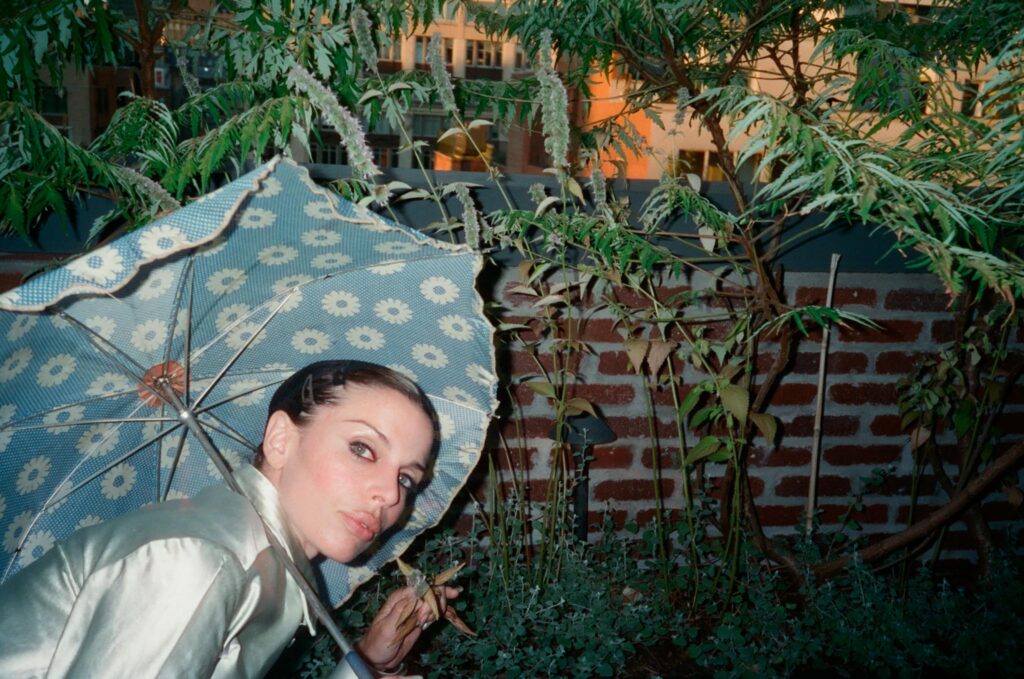
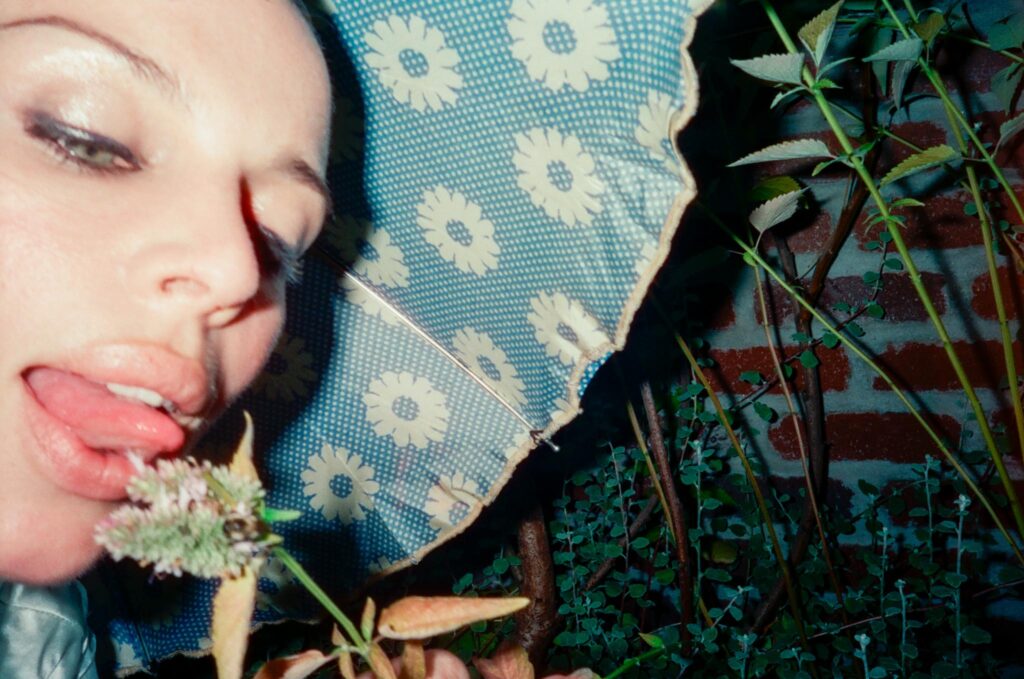
Shirt MARC JACOBS
“She’s always been the same,” says Luisa Opalesky, photographer and Fox’s friend of nearly a decade. “She’s very consistent—she is all-or-nothing herself.” And that singularity has been a consistent part of her story too. The New York Times described her as an “iconoclast,” and throughout all the years of reporting I’ve read for this story, I’ve never heard her called the next big X or be likened to Y. She is, as Charli XCX put it, “so Julia.”
When Fox and Opalesky reunite at the Chelsea for their first time shooting together without Valentino (Fox’s son), Fox is moving “like a spider monkey,” and she’s “down for shenanigans.” She roams the corridors and reclines on the perfectly made bed. She is a new-era New York legend inhabiting the haunts of many legends before her. She poses next to old baby photos of herself, featured in a personalised calendar her mother made for her, and reminisces about the past. Her first ever gig was the Strokes in Central Park in 2004—a concert she won her way into by snitching on scalpers to the police, who in turn let her in. (Years later, she’d endure a small-penised old man nicknamed “Smoking Stewart” play his band’s rendition of “every single song by the Strokes” during her first shift as a dominatrix.) Her first album was an Eminem CD, stolen from Best Buy. She was—and still is—obsessed with Courtney Love. She would hold seances in her childhood bedroom over her crush, Kurt Cobain (“That was my boyfriend, in my head, for sure”). She believes Roblox, or “whatever it is you boys do,” is killing creativity, and that we should bring back garage bands.
A few days later, Fox and I catch up on Zoom. She’s been back to the Chelsea twice in the meantime to shoot with fashion designer Betsey Johnson and is in the thick of her latest project: directing her debut feature. Sixth Avenue Saints is promised to be a “gritty” coming-of-age drama set in pre-gentrified ’90s New York (sound familiar?). The film follows a “sensitive and imaginative twelve-year-old boy” from Coney Island and “a fearless, homeless street kid” who introduces him to another side of the city. From her home, Fox talks of past ghosts, New York states of mind, and the importance of remembering.
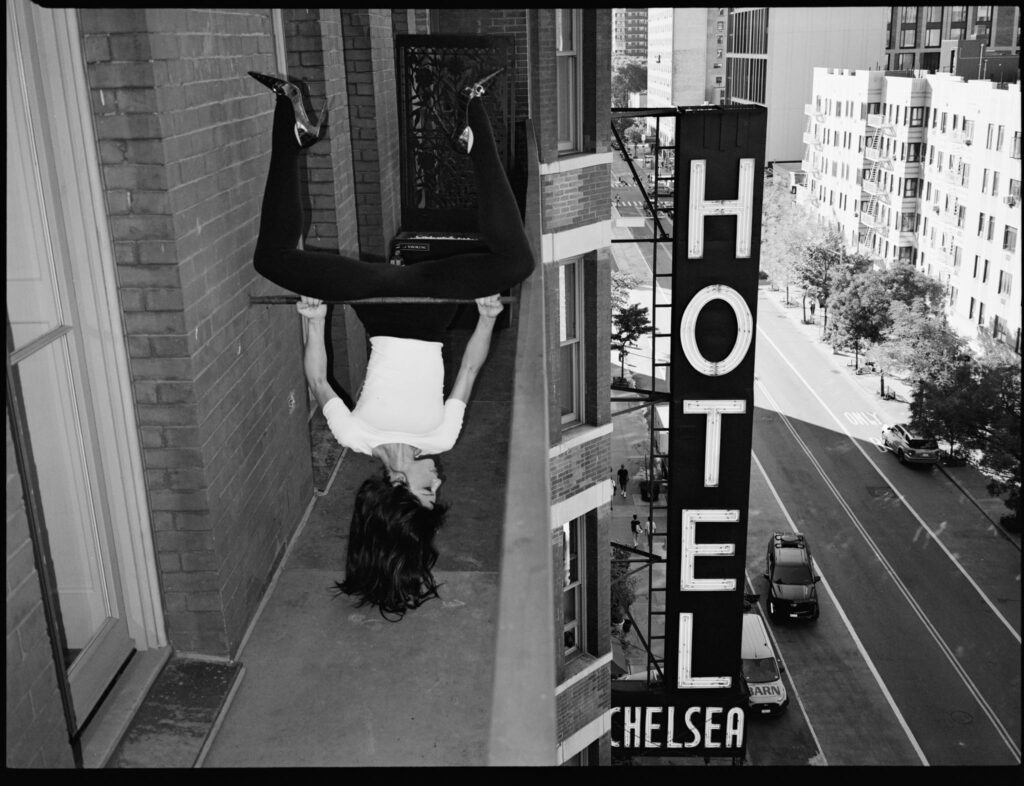

Full look GUCCI
HARRIET SHEPHERD: You strike me as a sentimental person. I remember watching your apartment tour—you had a “nostalgia mirror,” full of pictures and mementos. Have you always been like that?
JULIA FOX: Definitely. I feel like objects hold energy. They hold meaning and memories, and they should be respected and valued for that, you know?
HS: Do you find it hard to let go of things?
JF: I want to hold on to things… but then, I do have these moments where I’m purging, and I just have to get rid of everything. Sometimes I realise that I’m holding on to things from an unhealthy place. I’m very cognisant of stuff like that. I’m very self-aware; I know my patterns. Sometimes I hoard, and sometimes I throw things away at an insane rate, not even looking at what it is [I’m getting rid of], and I regret it later.
HS: You brought a calendar keepsake to the shoot…
JF: I have all these weird little things that my mom makes me. She’ll give me, like, a mousepad with a picture of me as a kid on it. [The calendar] is from 2015. It has all these cute baby pictures of me. And I never used it, so I was like, “Okay, at least you can have a moment.”
HS: Growing up in New York, what are your memories of the Chelsea?
JF: To me, it was just the Chelsea Hotel; I didn’t even know the lore behind it. I just know that we partied there, and that it was crumbling a little bit. It was a little bit neglected. It was a place you could really party. But it was always haunted. Like… always. We knew that. It was only later, with the internet and social media, and people talking and whatever, that I found out [about] all those people that died there—like Nancy [Spungen], so many people died there. I could definitely feel their spirits, because there was always some shit going on. I remember two weekends in a row [when] the fire department came at, like, four in the morning. It was just always weird stuff.
HS: What gave you the sense that it was haunted?
JF: It’s eerie: doors open and close, you’ll hear noises in the staircase… Maybe it’s just the wind going up the spiral staircases, but you can hear things. The phone will ring once, and then you’ll pick it up and no one’s there. Weird shit. One time, my friend said she saw a woman ghost—I never saw it, I was kind of like, “You’re just high,” but she was really freaked out.
HS: In one of the outtakes, you’re throwing towels like you’re conjuring spirits.
JF: We were being really kooky. [Luisa Opalesky] was like, “Throw the towels,” and then I threw an entire stack of towels, which hit the camera, which then hit her face. And I was like, oh my god! But that wasn’t a ghost, bitch, that was me.
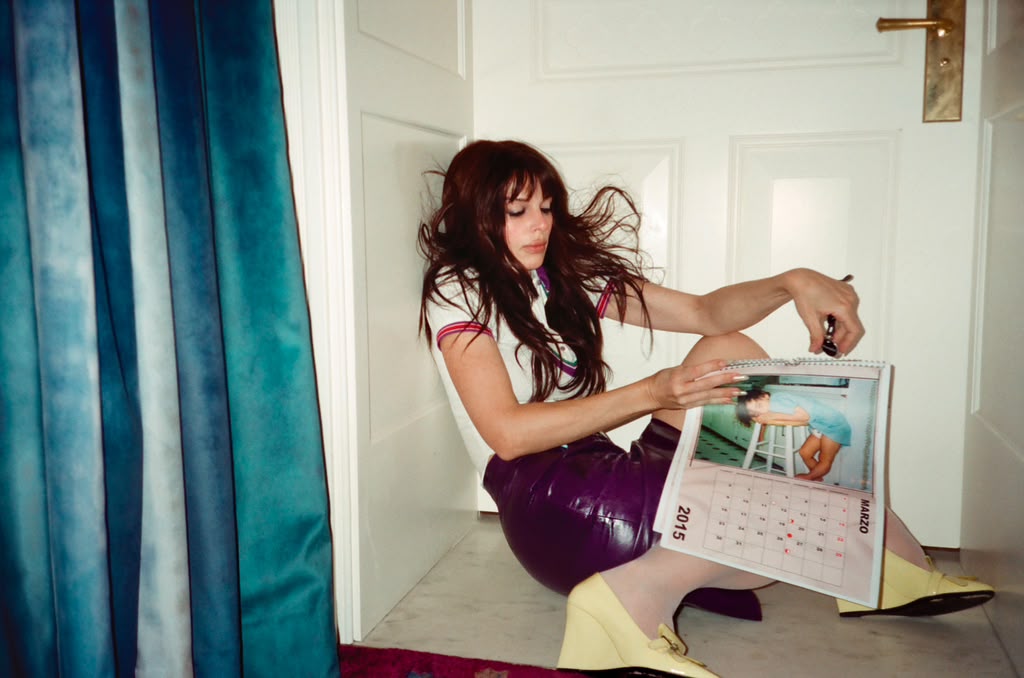
Top, skirt, and shoes SOFIA TESTINO Socks FALKE
HS: Have you ever seen a ghost?
JF: I’ve definitely had weird paranormal experiences, but I’ve never actually seen a ghost. I don’t think that’s possible. I don’t know… maybe it is. I think it’s more of an energy cluster, just kind of unhoused, moving around in another dimension that overlaps ours, and they’re just trying to find a place to become a body, but they can’t… or something… I definitely believe in the supernatural, the paranormal—but I don’t think it’s necessarily spooky or bad, you know?
HS: The mythology of the Chelsea is also based on indisputably real and verifiable figures. Many of these stories revolve around [co-owner and manager] Stanley Bard being a kind of patron of the arts, accepting paintings instead of rent, bolstering the creative community. Are there people like this in your story? Do you think these kinds of figures still exist?
JF: Not really. I mean, they do [exist], but not at that scale. I don’t think New York is the same New York from the era of the Chelsea Hotel. Do I think there are glimmers of it? Yes. Over the weekend I went to Clayton Patterson’s house—he’s like the godfather of the Lower East Side. He’s an iconic videographer and photographer; he filmed all the riots at Tompkins Square Park, and he has so much amazing footage of when [Rudy] Giuliani came in as mayor and bulldozed the city and really altered the fate of the Lower East Side forever. I was at his house, looking at all his art—he has art from everyone. And he’s such a connector to people. You go to him, “I need this,” and then he goes through his phone, and he’s like, “Here, take this person; they can help you and guide you along your spiritual quest of making art.” So there are still figures like that, but they’re of that era. They’re not of this era, sadly.
HS: What do you think about “this era”?
JF: People are really struggling. New York used to be a place for artists—and artists made it a desirable place to live. Then rich finance people moved in because they liked what the artists built. It’s so sad that they’re getting pushed out, but I really do love Mayor [Zohran] Mamdani’s efforts to create incentives for artists. Me and my friends always had this joke, back in the day: When someone was like, “I’m an artist,” [we were] like, “You have a trust fund.” Now it’s confirmed. It’s not even a joke anymore, it’s…
HS: A necessity?
JF: Exactly. But it also goes to show that when people have the funds and the security, they will choose art, and that’s beautiful. So many of us are artists [inside], but simply can’t [afford to be]. I always wanted to be an artist, but I literally couldn’t, because I had to hustle and I didn’t have my parents paying for a studio for me. So a lot of the art I made, I just made from my bedroom. But that was enough. That was enough to get me to a place where now, I could make art full time if I wanted to. And I do, in a way; it just doesn’t look the way I thought it would. But that’s fine. It’s better, I would even say.
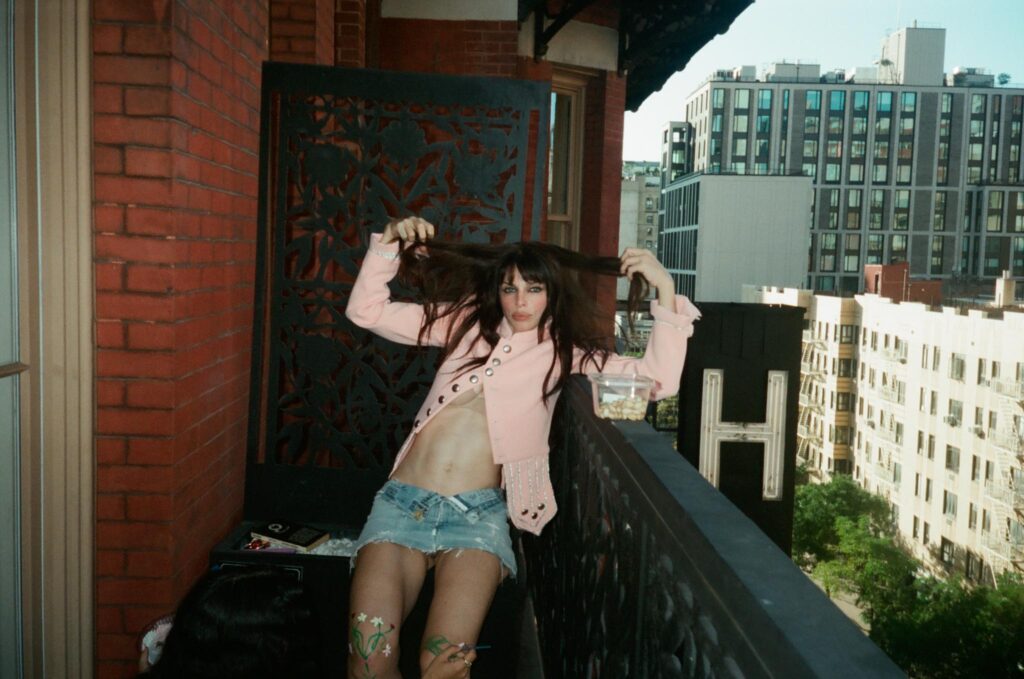
Jacket SOFIA TESTINO Denim belt SARAH APHRODITE
HS: How did you imagine it would look?
JF: I think for everyone [at that age], when they think “art,” they think “painter.” I thought I’d be painting. Which I can do, but it’s not what my heart beats for.
HS: You said the first movie you remember seeing in the cinema was The Fifth Element (1997). It’s a film set in a version of New York… albeit in the 23rd century. You talk in your book about seeing Kids (1995) and it being a mirror of your own New York experience. Now you’re directing your own New York story—what version of the city are you aiming to capture?
JF: A pre-9/11 New York. I know that’s pretty broad, but that’s when things really changed. [Over] the months and the years that followed, the vibe just changed. There was police everywhere, and everything just felt so… not free anymore. I remember prior to that, it was lawless, and we had so much fun; we didn’t feel like we were being surveilled. After 9/11, the vibe just shifted, and you were guilty until proven innocent. It didn’t have the same whimsy.
HS: I know you’re a big music person. I’m curious how you’re approaching the score, and how music is animating the story for you, either on or off set…
JF: Weirdly, at first I was like, I don’t think the film needs a score. There are so many films that I love that don’t have scores—Kids being one of them. New York is always buzzing, and it always has this hum; I kind of wanted that to just be the vibe. But then, in watching things back, I was like, oh, yeah, you definitely need a score. Because a score is more than just pretty music. It tells the audience what to expect, what to feel, what direction we’re heading in. It serves other purposes that I didn’t realise at first. It’s really important, actually, and it can make you feel crazy things. I have an idea of who I want to do the score, but it definitely needs to feel relevant to the world of the film. It’s not gonna be some random 60-year-old white man—let’s just put it that way.
HS: What other revelations have you had during the process of watching things back?
JF: I mean, everything. Every little thing. I’m just like, oh, wow, you know? Because it’s my first time really doing it at this scale of a full feature with 130 scenes.
HS: How would you describe yourself as a director?
JF: I’m a very emotionally-driven, intuition-based director. And not as much a technical director—if that makes sense. I had someone there with me to help me with all the technical terms. There are rules in making movies, right? But I don’t know any of them. I’m just like, “Let’s do it.” So it was kind of nice to have someone there that knew the rules, and then to have me there pushing back on them: “Yeah, but who cares if it’s the rule?” I understand why—if someone leaves the screen camera right, they have to come in camera left. So I was learning that as I was going, but most of the shots… We had a shot list, but I don’t think I looked at it once. I’d get to the location, then I’d close my eyes and envision it, and then I’d be like, “Okay, we’re gonna do it like this.”
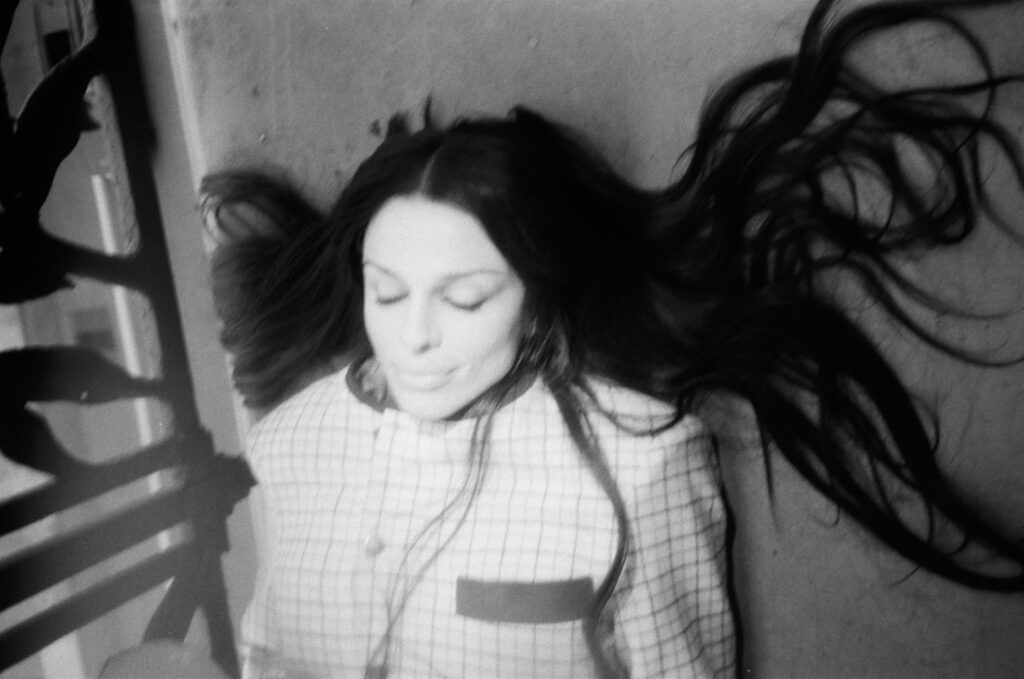
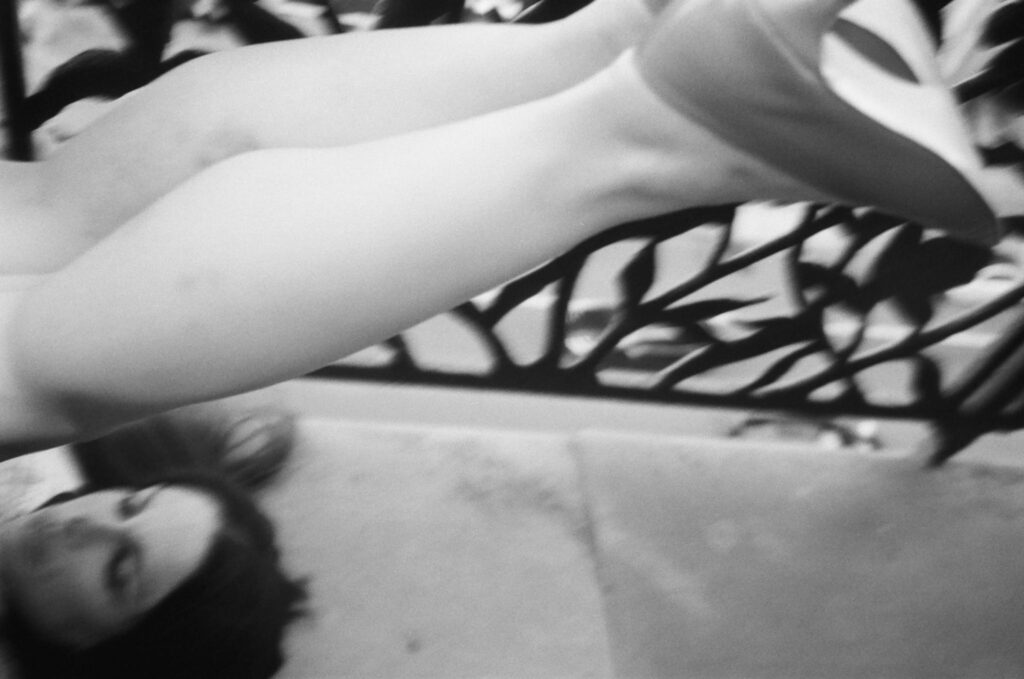
Jacket SOFIA TESTINO Shoes MARTINIANO
HS: I recently worked in theatre for the first time ever, and I came in thinking: I’m not qualified to do this in any way. But I was working with a director who sees the benefit of being free from those entrenched expectations of what theatre should or shouldn’t be. It’s interesting, then, what you can get out of it. You’re also street casting your actors—working with people who don’t necessarily have a preconceived notion of what film should be, or what a director should be, or what the rules are. Sometimes that’s where interesting things happen.
JF: Totally. And I was not directing from a director’s chair, at a monitor—I was in it. I was cleaning things, I was moving things, I was constantly on my feet. My DP was like, “You know, you should really just try one day to, like, sit at the monitor and just tell people what to do.” And I was like, “That’s just not me, you know?” Like, if I can do it, I’m gonna do it. It is exhausting—physically and mentally. But that was just my style.
HS: And working with kids… I can imagine that’s already a different ballgame.
JF: Definitely. But what I realised a lot about working with kids is that we had such an amazing vibe on our set. Truly, it was magical—and everyone was saying it, it wasn’t just me. I really think having the kids there was part of it, because when you have children around, as a grown-up, you show up as your best self—you always have to be smiling, or, I don’t know, just be in a good mood. I never lost my shit once, because I would never lose my shit in front of a child, or at a child. Having the children there made it that much more of a truly magical, incomparable experience.
HS: Your son is five now. Are there things from your childhood that maybe he’s not old enough to experience yet, but that you’re looking forward to sharing with him?
JF: A lot of it is movies or books…I share a lot of songs with him; we never listened to Kidz Bop or any of those songs when he was little… he really went straight into Nirvana. He knows who the Ramones are; he knows who the Beastie Boys are; he knows Metallica. And then he knows a lot of Italian techno music from the early 2000s, or house music. He’s very well-rounded in music, and he responds really well to it. We definitely like a lot of the same things.
We did watch Titanic when he was, like, four, and I think it was maybe a little bit soon, but he got it. He understood what was happening, and we were both at the end, like, hugging each other, crying. I definitely think that’s one of the more fun parts of being a parent—putting them onto stuff that’s gonna change how they view the world.
HS: Also re-experiencing it through a child’s eyes…
JF: Oh my god, yes. Because I remember what it meant for me when I discovered it. And to be like, “Look!” Even if it’s a music video. He saw something on a video game of cars drifting, and I was like, “Wait, watch this.” And then I put on that M.I.A. music video. Fuck, I forgot which one it is.
HS: ‘Bad Girls’?
JF: I think it is, actually. I was showing him all the clips of, like, the Saudi guys just riding their cars, like that—I remember what I felt when I saw that, having never seen that before, and how she kind of put that on a main stage, and how it kind of became a whole, like, thing. I showed him that, and he was like, “Whoa.” I’m always remembering things and being like, “Oh, wait, you’ll love this,” you know? One of the ways we bond the most is through an exchange of information, because he’s always showing me stuff too, and I pretend I’ve never seen it before.


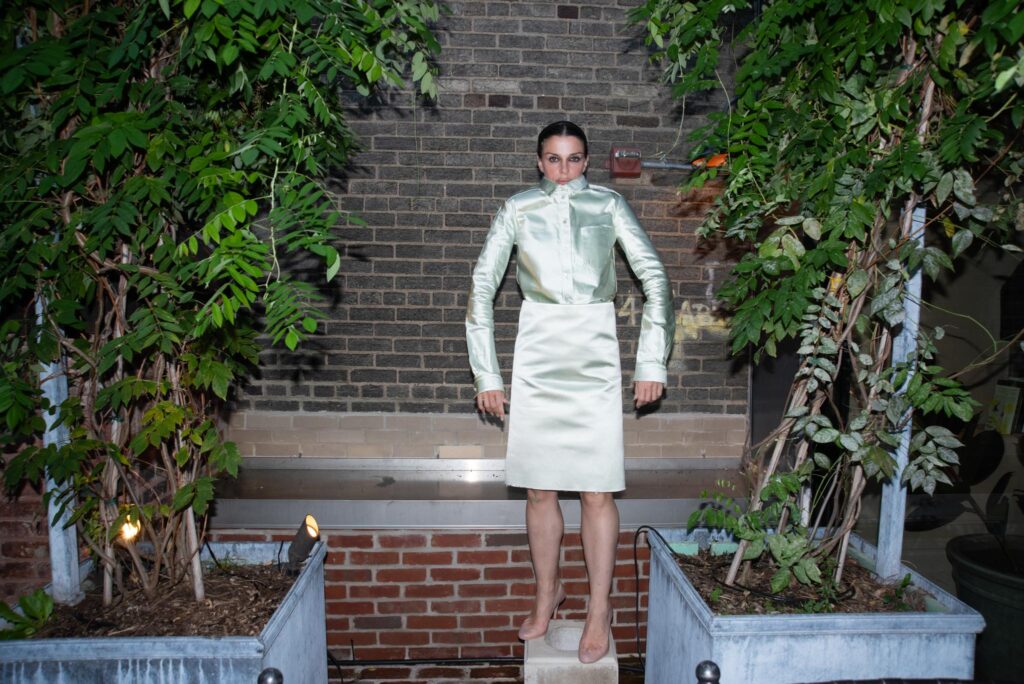
TOP LEFT: Jacket SOFIA TESTINO Skirt ECKHAUS LATTA Shoes MARTINIANO
BOTTOM LEFT: T-shirt SARAH APHRODITE Tights FALKE
TOP RIGHT: Shirt WILLY CHAVARRIA
BOTTOM RIGHT: Shirt and skirt MARC JACOBS Shoes ZELLOUS
HS: One thing that really struck me when reading your book was how vivid the memories were in it. Is that something that came naturally? I’m curious what the process was like for recolouring those memories. Who or what were you reliant on?
JF: A lot of it was core memories—you do remember all those weird little details, especially if there was trauma involved, because it kind of becomes frozen in time. A lot of times, I had a photo from that day, or I went back [and] read conversations, especially on Facebook. There were a lot of conversations on there. I could really pinpoint the day, and then piece things together. Because memory is so unreliable. It was like an investigative journalist investigating their own life. Like, did this happen like that? Like a puzzle: putting all the pieces together until it made sense. I think I got it to a place where if I remembered, if it was for sure a fact, I put it in. If not, I just omitted it. I was very committed to writing the truth. Like, if anything felt like it was an exaggeration, or a fabrication… it will never happen, you know?
HS: Who taught you the art of storytelling?
JF: I think just reading. I’m a very avid reader. I could always write, because I could always read. I think it’s really that simple.
HS: Were there formative books that really made you feel like you wanted to write?
JF: I always go back to Angela’s Ashes [by Frank McCourt (1996)], which is such a depressing book, but it’s the first adult book I read. I must have been nine years old. It was my dad’s book, and I had read all the books in the house, and then there was this. Just [McCourt’s] way of recounting his life in Ireland, and his mom having all these babies, and his dad being an alcoholic… That was the moment that I never read a children’s book again, if that makes sense. That was the moment I grew up. Something in me opened. I remember going back to school and having to read all these kiddie books, like by Judy Bloom, and I was like, the fuck is this? Like, I wanna read real fucking shit—because I saw myself in it.
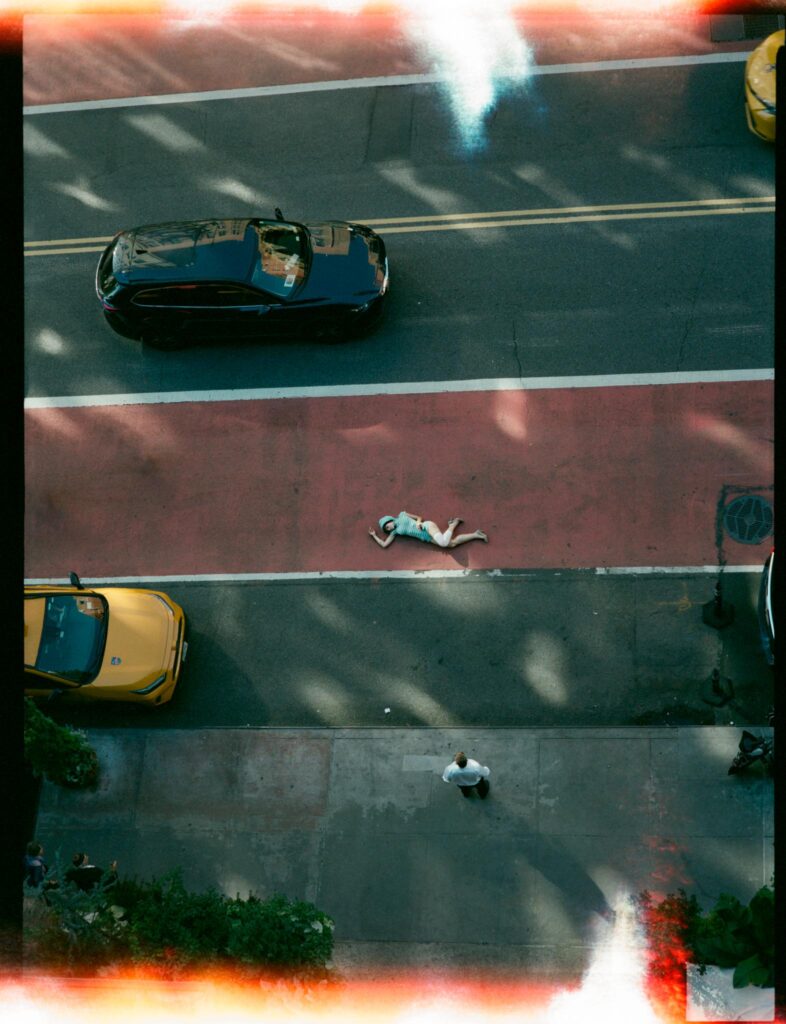
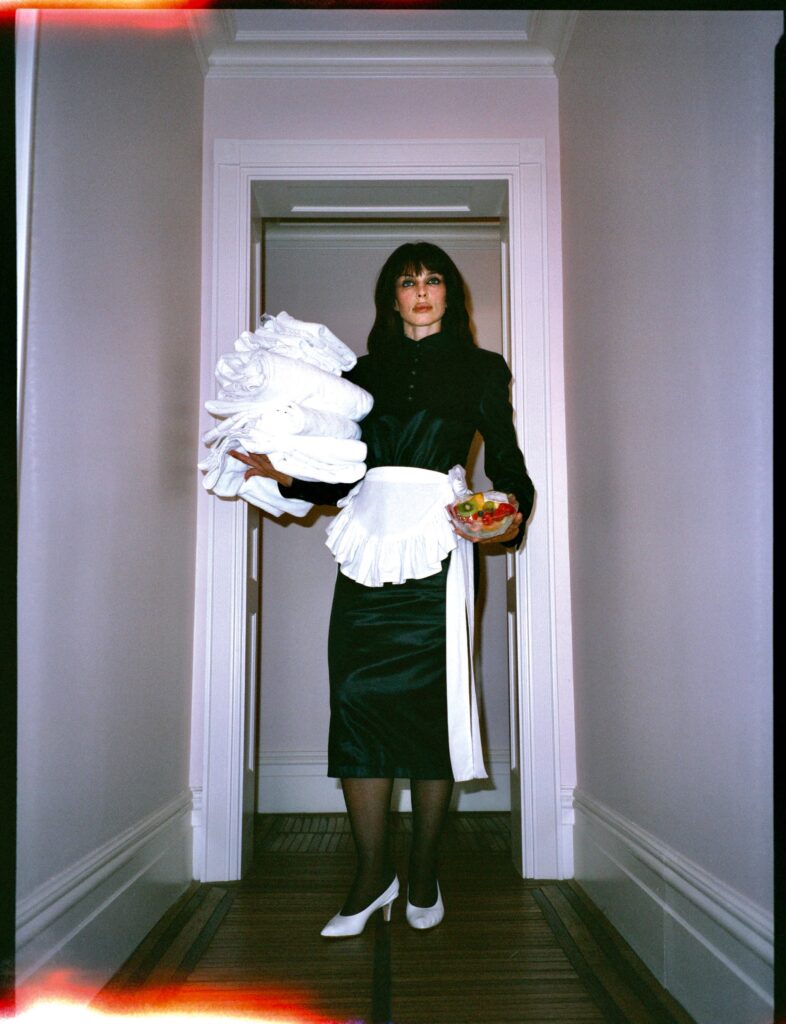
LEFT: Bodysuit MALENE SPECHT Leg garter SARAH APHRODITE Shoes MARTINIANO
RIGHT: Dress WILLY CHAVARRIA Apron SARAH APHRODITE Tights FALKE Shoes MARTINIANO
HS: How have you approached characterising this film—writing kids, especially? Are there other people, or other characters, that have inspired these characters?
JF: Yes, but not really. They’re figments of my imagination. Are our lived experiences similar? Yes, of course. But they’re just people I made up, in a world I made up… If you know people, then you know characters… It’s really just as simple as that. I have a knack for worldbuilding and character building. I love nuance, and I love things to not feel cliche. I love being surprised. Like, sometimes I get surprised where my characters go when I’m writing them. So I always kind of say, it writes itself—but I mean it, because sometimes I feel like I’m just a vessel, and all these ideas are coming through me. They’re not my ideas, if that makes sense.
HS: Do you keep journals?
JF: Yes. [For] a lot of my book, I was literally just referencing old writing that I had, too. And that was amazing, because I was like, I kind of remember, but that version of Julia, ten years ago, she was closer to that. She remembers better. So much of it was referencing old writing, but then rewriting it in my present tone.
HS: Bringing you closer to the feeling.
JF: Yeah. I always tell people, “Write shit down,” because you’d be surprised: we forget. My friends call me Master Forgetter—that’s how quickly I forget. Like, I move on, I forget.
HS: If you could write a postcard from the Chelsea to anyone living or dead, who would you send it to, and what would it say?
JF: Definitely Betsey Johnson. I was actually at the Chelsea yesterday with Betsey. She used to live there in the ’60s and in the ’70s and the ’80s, so she’s seen every single era—and she always ends up going back there. I would write her a letter from the Chelsea, telling her to move back into the Chelsea.
*This conversation has been edited for length and clarity.
Talent JULIA FOX
Photography LUISA OPALESKY
Styling RACHAEL RODGERS
Styling Assistants ANNELISE PIZZITOLA, CLARA DIMANSKI, & JULIA ZUCKERMAN
Photo Assistant EMILIE GATEAU
Hair JOHN NOVOTNY
Makeup JAKE DUPONT
Location HOTEL CHELSEA, NEW YORK